

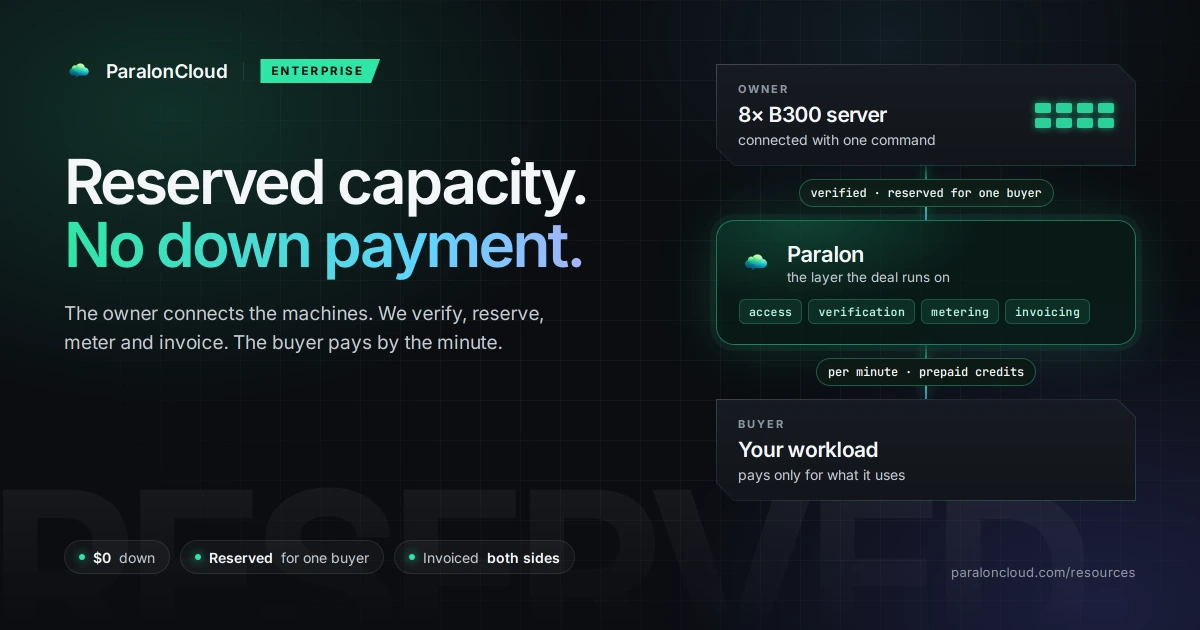
A request we see more and more: a team needs a large block of datacenter GPUs, say eight 8-GPU B300 servers, for 12 to 18 months, live within a few weeks, and asks for "flexible down payment terms": less upfront, credited to the final months, or spread over the first few.
That one sentence is where most capacity deals stall. On-demand B300 runs at roughly $6.65 to $6.95 per GPU-hour on the Silicon Data index as of 12 October 2026, so 64 of them around the clock come to well over two million dollars a year even at a reserved discount. The owner of that hardware wants a commitment and a large share of it paid in advance. The buyer, often a young company, wants to pay for capacity as it uses it. Each side is asking the other to carry the risk.
Paralon is built to sit in that gap. We are not a reseller holding capacity of our own, and we are not a broker who makes an introduction and steps away. We are the layer the deal runs on, from the first machine connected to the last invoice.
How reserved GPU capacity works through Paralon
| Owner | Paralon | Buyer | |
|---|---|---|---|
| Brings | the servers | access, verification, metering, payments, invoicing | the workload |
| Pays | nothing to join | per minute, from prepaid credits | |
| Receives | their share of every billed minute | a share agreed in the deal | verified capacity reserved for them |
- The owner connects the machines. One agent per server, installed with a single command. No inbound ports and no public IP: the node reaches us over an outbound tunnel. The owner chooses which GPUs join; the rest of the server stays theirs. See Add a Node.
- We verify every card before it serves. Each GPU is measured for memory bandwidth and compute, so it is listed with what it actually delivers, not what its name promises. How we do it: How We Prove a GPU Is Real.
- The capacity is reserved for one buyer. Reserved nodes are visible and rentable only by the entity they are reserved for. Nobody else on the network can see or take them.
- The buyer rents and pays per minute. Each rental is billed to the minute from the buyer's credit balance. Credits are topped up by card or by crypto (USDC or USDT on Solana, credited 1:1 in about a minute) and never expire. See Credits & Billing.
- The owner is paid from what is used. The owner's share of every billed minute, agreed when the reservation is set up, goes to their earnings balance as it accrues. See Payouts.
- Invoicing on both sides runs through us. The buyer receives invoices for what they pay in; the owner's side is invoiced for what their machines earned. Neither party has to chase the other for paperwork, or for money.
Reserved capacity without a down payment: where the risk goes
A down payment exists to protect the owner from a buyer who stops paying. Here the buyer never owes anything after the fact: every minute is paid from credits that are already in the account, and when the balance runs out the rental stops. The owner is never exposed to the buyer's credit.
That leaves one real question, and it is a commercial one: how much of the reserved capacity the buyer commits to use. It is agreed between the three of us when the reservation is set up. A common middle ground is a rolling balance: the buyer keeps, say, a month of expected usage in credits at all times. The owner sees a month of revenue already funded; the buyer has one month of capital tied up instead of a quarter or a year.
What the GPU owner and the buyer each get
For the owner
- A price agreed with the buyer for the hours the machines work, closer to on-demand than to a long-term discount on all of them.
- No counterparty risk: payment comes from prepaid balances, through us.
- A reputation built from clean rentals, which is what buyers choose by when the reservation ends.
- Machines that stay theirs: no hardware changes hands, and capacity outside the reservation can still serve the open network or be taken back. See Sell Spare Data-Center GPU Capacity.
For the buyer
- Reserved capacity without a down payment and without a long contract to finance.
- Billing to the minute, and nothing for time a machine is down: if a node stops answering, billing stops after five minutes. See Rent a GPU.
- Cards verified by measurement before they serve, and a record of how each node has behaved on earlier rentals.
- Rentals by hand or by API: the Rental API starts, lists and stops rentals from a script, a scheduler or an agent.
Which workloads fit best
Workloads that run within one server: inference at scale, fine-tuning, evaluation, batch and synthetic data jobs. A rental is a container on one machine with up to all of its GPUs, reached through a Jupyter Lab environment with a terminal. Uptime on the machine is the owner's job and the platform's is ours; how that line is drawn and enforced is in Who Owns Uptime on a Rented GPU.
How to reserve GPU capacity, or offer yours
The offer, for each side, is on Paralon Enterprise: reserved capacity.
If you need capacity, write to [email protected] with the GPU model, how many, where, for how long, and what will run on it. If you already have an owner in mind, bring them: the arrangement works the same way.
If you own capacity and would rather earn on it per minute than sell it at a reserved discount, connect a first server (Add a Node) and write to the same address. We will tell you what is being asked for on your hardware.
If you broker capacity for your own customers, Paralon can be the layer under your deals: you bring both sides, we run access, verification, metering, payments and invoicing.
Frequently asked questions
Can I reserve GPU capacity without paying upfront?
Yes. There is no down payment. You top up credits and they are spent per minute on the nodes reserved for you. The usual arrangement is a rolling balance, for example a month of expected usage kept in credits, instead of prepaying a quarter or a year.
Who owns the GPUs?
The owner keeps them. Paralon does not buy or hold the hardware: we run the layer between owner and buyer, which is access, verification, metering, payments and invoicing.
Can anyone else rent capacity reserved for me?
No. Reserved nodes are visible and rentable only by the entity they are reserved for. Nobody else on the network can see or take them.
How is the GPU owner paid?
The owner's share of every billed minute, agreed when the reservation is set up, goes to their earnings balance as it accrues and is paid out from there. The owner's side is invoiced through Paralon for what their machines earned.
Which GPUs can be reserved?
Datacenter and workstation GPUs such as B300, B200, H200, H100, A100 and RTX PRO 6000, whatever the owner connects. Every card is measured for memory bandwidth and compute before it serves.
Who sets the price of reserved capacity?
The owner and the buyer agree it between them when the reservation is set up, per GPU-hour, and Paralon bills it by the minute. Nothing ties a reservation to a list price.
What happens if a reserved machine goes down?
If a node stops answering, billing stops after five minutes, so the buyer does not pay for downtime. The owner is alerted, and host faults count against the node's reputation.
What access does the buyer get on a reserved node?
A container on the machine with up to all of its GPUs, reached through a Jupyter Lab environment with a terminal. Rentals can also be started, listed and stopped from code through the Rental API.
I broker GPU capacity. Can I run my deals on Paralon?
Yes. Bring the owner and the buyer; Paralon runs access, verification, metering, payments and invoicing under the deal. Write to [email protected].