

Over the past few weeks we have watched a clear pattern form on Paralon: a wave of users renting GPUs not to run inference or training, but to mine Pearl. If you have seen the ticker PRL show up and wondered what it is and whether you can mine it on rented hardware, this guide walks through both: what Pearl Research actually is, and how renting GPUs on Paralon fits into it.
We will keep this strictly to what Pearl Research has published. Mining is volatile and the economics change block to block, so treat everything below as a technical explainer, not financial advice.
What is Pearl?
Pearl is a Layer-1 blockchain built by Pearl Research Labs. It calls itself "the Bitcoin of the AI compute era": a permissionless monetary network that replaces Bitcoin's wasteful proof-of-work with the native operation underlying modern AI, matrix multiplication.
The headline numbers Pearl publishes:
- Token: Pearl coins, ticker PRL
- Total supply: 2,100,000,000 coins
- Smallest unit: a "grain" (10⁻⁸ of a coin)
- Block interval: 194 seconds
- Mainnet: the chain went live when the node code was made public on April 27th
Instead of discrete halvings like Bitcoin, Pearl uses a polynomial decay emission curve, reaching roughly half of supply after about four years.
Why "Proof of Useful Work" matters
Bitcoin mining spends electricity solving hashes that have no value outside of securing the chain. Pearl's pitch is that the work itself should be useful. Its consensus is Proof-of-Useful-Work (PoUW) built on matrix multiplication, the same operation that powers every modern AI model.
In Pearl's design, miners take input matrices, add cryptographic noise, compute the product, and the protocol generates proofs (using Plonky2 zk-SNARKs and BLAKE3 hashing) that the multiplication was done correctly. As Pearl puts it: "Block rewards are generated in direct proportion to verifiable matrix multiplications."
Two consequences fall out of this design that are relevant to anyone renting hardware:
- It is ASIC-resistant by construction. Pearl notes that matrix multiplication is "the native language of all modern AI accelerators," so there is no specialized chip that beats a GPU at it the way ASICs crushed Bitcoin GPU mining. The hardware that mines Pearl is the same hardware that runs AI.
- It targets the GPUs people already rent. Pearl's economic analysis references commodity datacenter GPUs like the H100 and H200 directly.
Pearl Research has also shipped a vLLM plugin and a "Pearl-certified" version of Meta's Llama 3.3 70B, leaning into the idea that the network's work and real AI inference are the same primitive.
Which GPUs can mine Pearl?
Pearl's community miners support a broad range of NVIDIA architectures:
- Volta: V100, Titan V
- Ampere: RTX 30-series, A100
- Ada: RTX 40-series, L4 / L40
- Hopper: H100, H200
- Blackwell: RTX 50-series, B100 / B200
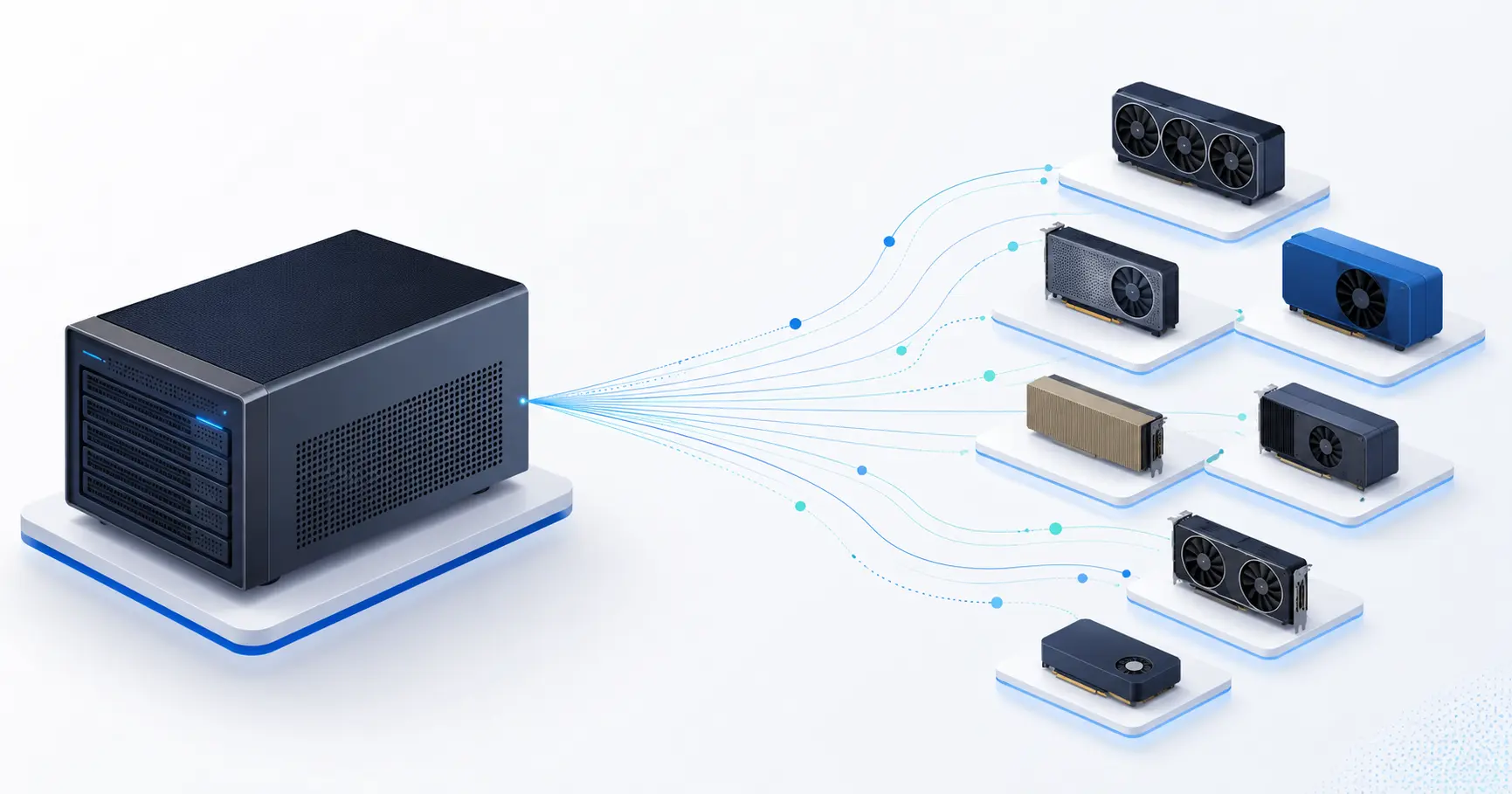
This maps almost one-to-one onto the GPUs already listed on Paralon's marketplace, which is exactly why we have seen renters point their instances straight at a Pearl pool.
Why rent instead of buy
Buying a rack of H100s to test a new chain is a five-figure-plus commitment before you know whether the economics work for you. Renting flips that:
- No capital outlay. Spin up a verified GPU by the minute and stop when you want.
- Try before you commit. Benchmark your hashrate and the current PRL economics on real hardware before buying anything.
- Scale up or down instantly. Add GPUs when difficulty or price moves in your favor, release them when it does not.
- Global, verified supply. Paralon's nodes are health-monitored and verified, so you are renting from real, vetted hardware.
This is the same reason Paralon exists in the first place: GPU compute should be something you access on demand, not something you have to own.
How to rent a GPU on Paralon and start mining
- Sign in at Paralon Cloud and open the Rent marketplace.
- Pick a GPU that matches a Pearl-supported architecture above, such as an RTX 4090, RTX 5090, A100, or H100/H200. You can compare hourly rates per card on the pricing page.
- Launch an instance with SSH or Jupyter access. You pay per minute, with no long-term contract.
- Install the Pearl miner for your chosen pool and point it at that pool's stratum endpoint with your PRL payout address.
- Monitor your hashrate and rewards from the pool dashboard, and stop the instance whenever you are done.
Because Paralon bills by the minute, you can run a short test, measure what a given GPU does on Pearl, and only scale if the numbers make sense for you.
Where Pearl is mined
Several community pools serve the Pearl network today. You can track all of them, plus blocks and network stats, on the Pearl explorer tooling at prlscan.com.
As of late May 2026, prlscan reported roughly 10.3 EH/s of pool hashrate (about 52.6% of total network hashrate), 361 blocks found in 24 hours, ~1,028,198 PRL paid out across pools, and over 55,000 workers online. A snapshot of the active pools at that time:
| Pool | Fee | Reported hashrate | Miners | 24h blocks | 24h paid |
|---|---|---|---|---|---|
| PearlHash | 3.0% | 4.87 EH/s | 4,647 | 182 | ~532,356 PRL |
| AlphaPool | 6.0% | 3.52 EH/s | 2,700 | 135 | ~376,727 PRL |
| Akoya | 5.0% | 1.23 EH/s | 2,540 | 30 | ~76,078 PRL |
| LuckyPool | 1.0% | 0.68 EH/s | 1,035 | 14 | ~40,339 PRL |
| MinePRL | 4.4% | 0.02 EH/s | 20 | 0 | ~2,698 PRL |
Those figures move constantly. Hashrate, fees, and the number of miners all shift block to block, so check prlscan for the live picture before you choose a pool. Always follow each pool's own current documentation for the exact miner binary, stratum URL, and configuration.
A note on doing your own math
Mining returns depend on PRL's price, network difficulty, your GPU's throughput, and your rental cost per hour, all of which move. Pearl is a young network that launched in April, and PRL trades on third-party venues with the volatility you would expect from a new asset. Rent a single GPU first, measure your actual results against your rental cost, and only scale once the economics are clear to you. Nothing here is a promise of profit.
Ready to try it?
If you want to experiment with mining Pearl without buying hardware, the fastest path is to rent a supported GPU on Paralon, point it at a pool, and measure for yourself. Browse available GPUs on the Rent marketplace, check the pricing page for hourly rates, and launch one in a couple of minutes.