

On 20 October Business Insider reported that some of the Nvidia GB300 racks Amazon is buying sit in warehouses, waiting for data centers that have the floor space for them but not the electricity to turn them on. Internal emails it quoted put the deliveries at about $5 billion of racks in August and roughly $3 billion a month after that. Amazon now takes ownership of the hardware before its sites are ready, under a programme the emails call Early Rack Receipt (coverage of the report, another summary). Amazon has described staging hardware near its sites as normal practice.
Whatever the size of Amazon's backlog, the report says something plain about the market in late 2026: the hard part is no longer only getting the chips. New GPUs come with long lead times, which is why Amazon takes ownership early rather than lose its place in the queue, and once they arrive there often isn't power to run them. Capacity that has cleared both is the scarce kind. Morgan Stanley has warned of a power shortfall of around 32 gigawatts for US data centers through 2028 (as cited here).
The scarce GPU is the one already delivered and plugged in
A GB300 in a warehouse earns nothing and costs its owner every month it waits. A B300 or GB300 that is racked, cooled, connected and switched on is the thing buyers are queuing for. If you run a data center or a neocloud, you already have what the biggest buyer in the world is paying ahead to secure: capacity that works today.
That changes what an idle hour is worth. Between two reserved contracts, after a training run ends early, while a customer ramps up slower than planned: those hours used to be an accepted loss. With power the bottleneck, they are the most valuable hours in the building, because nobody can add more of them quickly.
Three ways to sell powered hours without giving up the next contract
The catch for an owner has always been control. Selling spare capacity through a long contract or a reseller's control plane means you can't take it back when the next customer signs. On Paralon the server stays yours and you choose, per server, how it is sold.
By the minute, between contracts. Connect a server with one command, with no inbound ports or public IP. Our agent measures every GPU before the server is listed and again after every reboot, so renters see what they get. Renters pay for every minute; you keep 80%.
As a spot node, when a contract may land at any time. Mark the server spot and it rents at a lower price, and you can take it back whenever you need it: a running rental gets two minutes' notice, then stops. Your price stays yours, set between half and the full on-demand price. How spot nodes work.
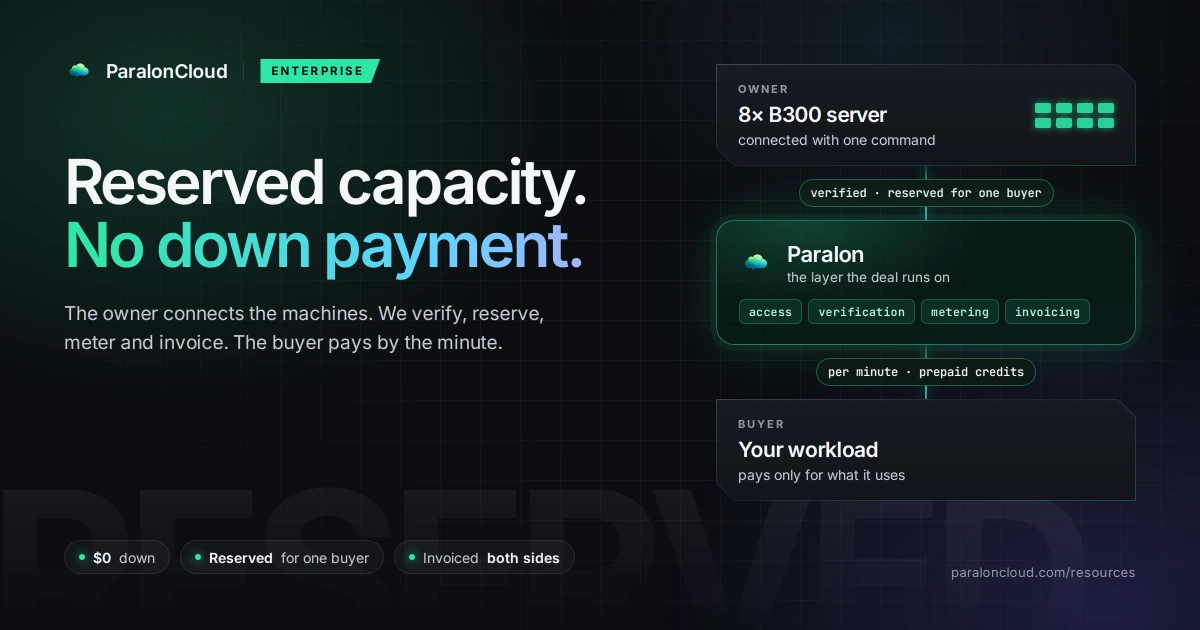
Reserved, on your terms. For buyers who need a block of servers for months, list the capacity in the capacity directory with your price, minimum term and down payment, or none. We review every company and listing, and buyers' requests come to you in one conversation with us. How listing works.
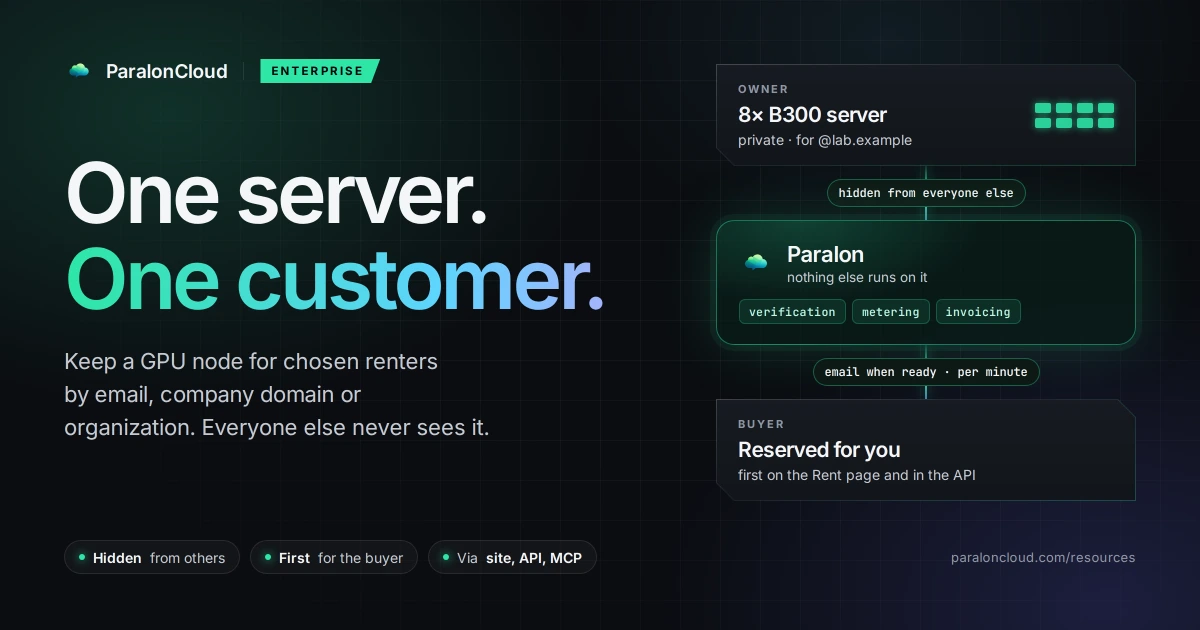
Two things make this fit how a data center already runs. A private node is hidden from everyone except the renters you choose, by email, company domain or organization, so the same server can serve your own client through us. And the Provider API and our MCP server let your own systems or an AI agent set availability, price and reclaim across the fleet, so the scheduler you already have decides what is for sale. Provider API.
What to check in your own fleet this week
- Which servers sit idle between contracts, and for how long? Gaps of a few days are worth selling by the minute; gaps of months are worth a reserved listing.
- How quickly do you need a server back? If the answer is "when the contract is signed", spot with two minutes' notice covers it.
- What is your floor price? Power, cooling, space and depreciation per GPU-hour. Price every listing above it; idle hours earn nothing at any price. Companies are paid by bank in US dollars against their own invoice.
- Who should see each server? Public, private for one client, or reserved for one buyer.
Why this lasts beyond one news cycle
Amazon reports its quarter on 29 October, and the numbers will say how much of its new capacity has switched on. But the pattern behind the story outlasts it: chips and power both arrive slower than demand, so capacity that is already delivered and powered keeps its premium. The data centers that sell their idle hours well over the next two years won't be the ones with the most GPUs. They will be the ones whose GPUs are never dark.
If you have B300 or GB300 servers with hours to spare, list your capacity or connect a server.